


Earning your full G license in Ontario is a big milestone that grants you unrestricted driving freedom across Canada and beyond. Despite possessing their G2 license for at least 12 months, many Ontario drivers are nervous about taking the G test and with good reason. According to statistics, some drivers do not pass on the first try, frequently owing to avoidable errors and insufficient preparation.
The Ontario G Test is more than simply a driving test; it’s your ticket to unlimited driving rights, may help lower insurance costs, and the confidence that comes with being a fully licensed driver. Whether you’re a young driver looking to upgrade from your G2, a new immigrant working for your full Hamilton license, or a parent assisting their teenager, this thorough guide will provide you with everything you need to pass the G test on your first try.
At GClassDrivers, we’ve successfully guided hundreds of students to full licensure. Through our expertise, we’ve identified the most prevalent errors, the most effective preparation tactics, and insider information that may be the difference between passing and failing. This guide distills that knowledge into practical suggestions you can use right away.
Understanding the Ontario G Test: Your Path to Full Licensure
What Exactly Is the Ontario G Test?
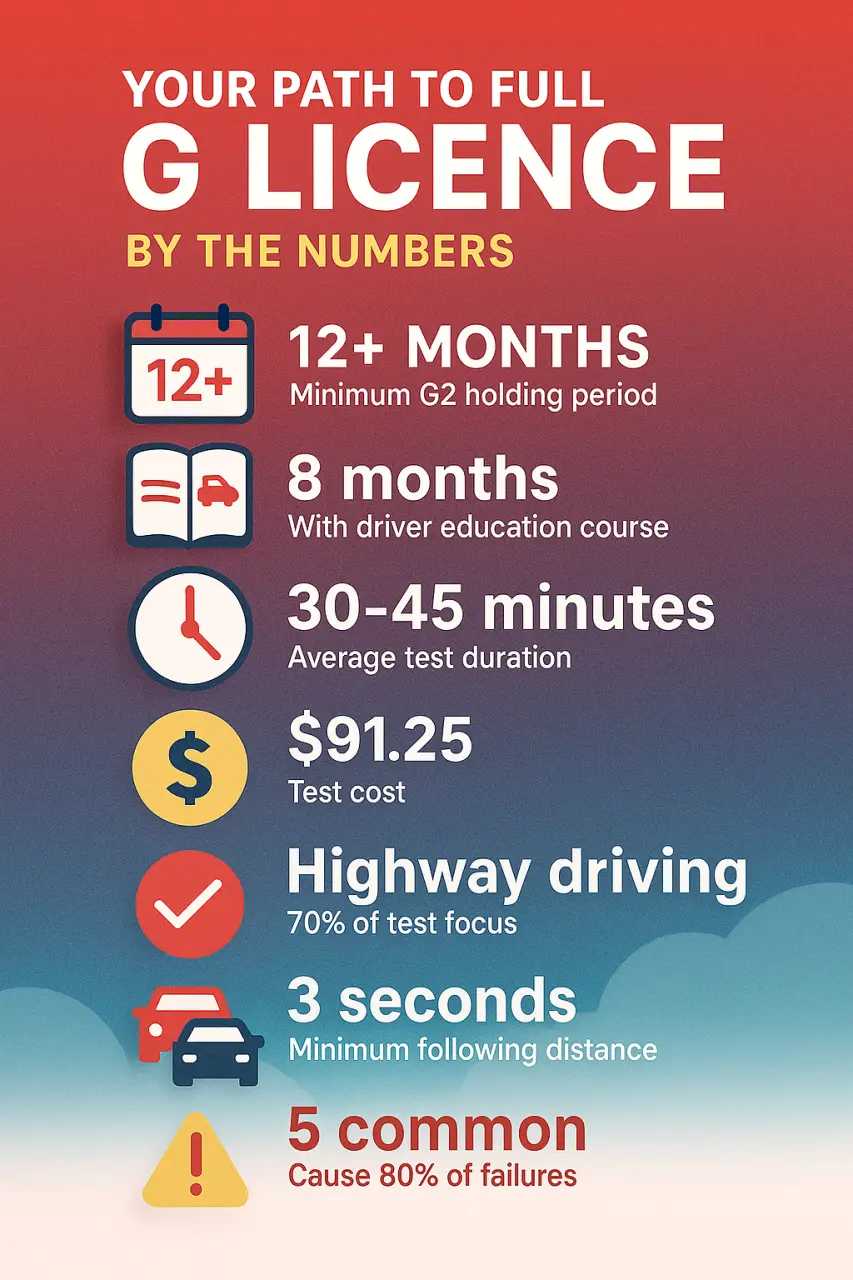
The G test is the G2 exit road test. Passing it moves you from a G2 to a full G licence. Unlike the first road test, it focuses on advanced skills, including highway driving: merging on and off, keeping an appropriate speed and space, and signalling. It also covers turns, curves, lane changes, intersections and driving in business areas.
Eligibility Requirements for the G2 to G Test Upgrade
To take the G2 exit road test you must:
- Hold a G2 licence for at least 12 months
- Have a valid licence that is not expired. If your G2 is about to expire, check the official rules on how to renew your place in the program.
- Finish the whole graduated licensing process within five years, or you start over
The 8-month option applies to the G1 stage if you complete a government-approved driver education course, not to the G2 stage.
Cost and Administrative Details
Road test fees are set by DriveTest and can change, so check the current DriveTest fee list before you book. Cancel at least 48 hours ahead to avoid a cancellation fee. You can book online, by phone (647-776-0331 or 1-888-570-6110) or at any DriveTest centre. Have your Ontario licence number and expiry date ready, and choose a first, second and third preferred location.
DriveTest centres across Ontario offer the G road test, including Hamilton East and Burlington. Wait times vary by location and season, so book early.
Top 5 Common Mistakes That Cause Ontario G Test Failures
Understanding why drivers fail the G test is critical for your success. Based on our significant expertise at GClassDrivers.com, below are the five most common errors that result in automated failures:
1. Speed Management Issues: The Issues of Going Too Fast or Too Slow
The Problem: Maintaining speed can be an issue for many drivers who are either going relatively faster, given the conditions, or extremely slow, for traffic flow to manage effectively. On the highway, driving well below the limit can be equally detrimental as speeding, for it disrupts the flow of traffic, creating hazardous conditions.
Why It Happens: Some drivers overtighten their grip on the steering wheel and take it slow, whereas other times, they overcorrect and drive fast. Other times, driving just seems to come naturally; with this feeling comes a higher risk, and consequently, the drivers may not feel too relaxed while driving in that situation.
The Solution: Practicing driving at a constant speed keeping in mind the traffic flow and staying under the limits. On highways, try to drive at the limit or slightly below it, traffic permitting, but do be prepared to adjust to a safe speed relative to that flow. The important part to remember is to drive smoothly and predictably above all else. Speed laws are there to guide you in doing this.
2. Improper Lane Changes and Highway Merging
The Problem: Failed lane changes are one of the most prevalent causes of G test failures. This includes poor shoulder checking, cutting off other cars, and failing to indicate properly during merges and lane changes.
Why It Happens: Many G2 drivers lack the necessary split-second decision-making and spatial awareness for highway driving. The greater speeds and various lanes might be daunting, resulting in hesitancy or poor decision-making.
The Solution: Learn the “mirror-signal-shoulder check-go” routine for each lane change. Practice merging at highway speeds, looking for proper openings in traffic rather than pushing your way in. Always indicate ahead of time and change lanes aggressively after you’ve verified it’s safe.
3. Insufficient Blind Spot Checking
The Problem: Failure to complete proper shoulder inspections before changing lanes or merging results in an automatic failure on the G test. Many drivers depend too much on mirrors, not realizing their limitations.
Why It Happens: G2 drivers may have formed habits of little shoulder monitoring when driving in cities, where speeds are lower and the repercussions are less severe. The change to highway speeds necessitates heightened blind spot awareness.
The Solution: Develop the practice of doing obvious, purposeful shoulder checks whenever you change lanes, combine, or even pass parked automobiles. Make your head motions plain and noticeable to the examiner; discreet glances are insufficient during the examination.
4. Right-of-Way Violations and Yielding Errors
The Problem: Alternative right-of-way scenarios-During the phases of highway on-ramps, roundabouts, melding into traffic, where confusion could occur, put the entire process of examination, and any life that may be in danger.
Why It Happens: Right-of-way regulations are difficult, and real traffic scenarios do not always conform to textbook examples. Timed test pressure will find these drivers doubting certain of their judgments, or making rash judgments.
Solution: Training should include lots of study of right-of-way situations and on-the-road experience with them. A general presumption is that merging traffic defers to highway traffic, but highway traffic should do its best to safely accommodate merging traffic. When in doubt, drivers should always choose the option that has the least risk and yield.
5. Weak Signalling and Mirror Checks
The Problem: In all cases, when a test person experiences inadequate acceleration on an on-ramp, when merging is either too slow or has come to a stop during the merging process, the result is a failure of the test at that point.
Why It Happens: Some drivers will merge because of a fear of the highway speeds, while others might not really appreciate that merging means matching the speed of interstate traffic before trying to enter it.
The Solution: Use the full length of the acceleration lane before reaching highway speeds – ideally equal to or just above the speed of the traffic that you are merging into. Signal early, find a proper space, and then merge boldly without coming to a stop unless necessary for safety reasons.
Proven Tips to Pass the Ontario G Test on Your First Attempt
Success on the G test comes down to preparation, practice, and the right mindset. Here are our most effective strategies:
Master Highway Driving Fundamentals
The G exam is based on highway driving, thus you must succeed in this area. Spend substantial practice time on 400-series routes under varying traffic circumstances. Focus on:
• Smooth acceleration and deceleration: Avoid sudden speed changes that can unsettle passengers or nearby vehicles
• Proper following distances: Keep a safe following distance and increase it in rain, snow or heavy traffic, increasing in poor weather or heavy traffic
• Lane positioning: Keep your vehicle centered in your lane, avoiding weaving or hugging lane markers
• Anticipatory driving: Scan far ahead for potential hazards and adjust your driving accordingly
Practice at several times of day to encounter diverse traffic loads. Light traffic allows you to focus on basic abilities, but moderate traffic teaches you how to manage real-world highway circumstances.
Develop Comprehensive Road Sign and Speed Limit Knowledge
While you may have learned fundamental signs from your G1 and G2 examinations, the G test requires knowledge of more sophisticated signage, particularly highway-specific signs. Study:
• Highway entrance and exit signs: Understanding warning signs helps you prepare for lane changes and exits
• Variable speed limit signs: These electronic signs adjust speed limits based on conditions
• Construction zone signage: Temporary signs require immediate recognition and response
• HOV lane markers: High-occupancy vehicle lanes have specific rules and restrictions
Don’t just memorize signs – understand their practical applications and how they should influence your driving decisions.
Maintain Calm Focus Throughout the Test
Test anxiety can derail even well-prepared drivers. Develop strategies to stay calm:
• Arrive early: Give yourself time to settle in and review your preparation mentally
• Breathe steadily: Deep, controlled breathing helps maintain focus and reduces physical tension
• Talk yourself through maneuvers: Quiet self-talk can help you remember proper procedures
• Accept minor mistakes: Don’t let small errors cascade into bigger problems – stay focused on the current driving task
Remember that your examiner wants you to succeed. They’re evaluating your safety and competence, not looking for reasons to fail you.
Invest in Professional Pre-Test Training
While friends and family can give important practice opportunities, professional training provides benefits that amateur coaching cannot match:
Expert Assessment: Professional teachers can detect and modify harmful habits that family members may not notice or know how to deal with
Test-Specific Preparation: Driving instructors understand exactly what examiners look for and can prepare you for the specific requirements of the G test.
Confidence Building: Professional classes in the weeks running up to your test will help you gain confidence and guarantee you’re properly prepared.
Vehicle Familiarity: Many driving schools offer test-day vehicle rental, allowing you to take your test in a car you’ve practiced with.
At GClassDrivers.com, our qualified instructors have helped hundreds of students pass their G test on the first try. Our tailored G test preparation curriculum focuses on the abilities and circumstances you may experience on the exam.
Your Complete Ontario G Test Preparation Checklist
Documents and Requirements for Test Day
Ensure you have all required documentation:
- Your valid Ontario driver’s licence
- A vehicle that is insured, has a valid licence plate and is in safe working order
- Glasses or contact lenses if you need them to drive
- Arrive early so you are calm before the test starts
The Week Before Your Test
7 days before: Last practice covering everything in great roads, city streets, and parking maneuvers.
5 days before: Go back and read the Official MTO Driver’s Handbook, especially for highway driving and advanced maneuvers.
3 days before: Should it be possible, do a practice test route, or simply cruise the area around the test center as preparation for local road conditions anticipation.
1 day before: Resist the temptation to do some last-day driving practice and do a light review instead. Get good rest.
Test Day: Morning: Light breakfast; 30 minutes before the appointed time, arrive at the center for 5 minutes.
During the Test: Key Success Strategies
Communication: Listen carefully to the examiner’s instructions and ask for clarification if needed. Clear communication prevents misunderstandings.
Demonstration: Make your safety checks obvious – exaggerated shoulder checks and mirror adjustments show the examiner you’re following proper procedures.
Recovery: If you make a minor error, don’t panic. Continue driving safely and focus on executing the remaining test elements correctly.
Patience: Don’t rush through maneuvers. Smooth, deliberate actions score better than hurried attempts.
Expert Resources and Professional Training
Why Choose Professional Ontario G Test Preparation?
While independent practice is valuable, professional instruction provides advantages that can make the difference between passing and failing:
Structured Learning: Professional programs follow proven curricula that systematically address all test requirements, ensuring no critical skills are overlooked.
Personalized Feedback: Certified instructors can identify your specific weaknesses and provide targeted instruction to address them.
Test Simulation: Professional schools can recreate test conditions, helping you become comfortable with the examination format and reducing test-day anxiety.
Vehicle Availability: Many students don’t have access to appropriate vehicles for practice or the test day. Professional schools typically offer well-maintained vehicles specifically prepared for road tests.
GClassDrivers: Your Partner in G Test Success
At GClassDrivers.com, we specialize in helping Hamilton drivers achieve their full licensing goals. Our comprehensive G test preparation program includes:
Pre-Test Assessment: We evaluate your current skills and create a customized preparation plan addressing your specific needs.
Trained for Highway Driving: Our trainers provide heavy driving instruction on the highway so that you will feel at ease with merging in high-speed conditions, lane changes, and multi-lane driving.
Mock Testing: We hold mock tests in conditions mimicking the actual G tests to let you familiarize yourself with the format and target anxiety during the test.
Flexible Scheduling: We offer driving lessons that fit your schedule, during evenings or weekends.
Support on Test Day: We provide vehicle rental services and accompany you for final preparations and moral support on your test appointment.
Additional Resources for Continued Learning
Beyond formal instruction, we recommend several supplementary resources:
Online Practice Tests: Regular online testing helps reinforce theoretical knowledge and identify areas needing additional study.
Defensive Driving Courses: These courses, while not required, can enhance your skills and potentially reduce insurance costs after obtaining your full license.
Driver Communities: Online forums and local driver groups can provide practical tips and moral support from others who have recently completed their G test.
Take Action: Your Path to G Test Success Starts Now
With proper preparation, practice, and guidance, you can walk away with passing results amongst many who flunk. One must go about preparing to pass in a full yet flexible systematic manner, addressing potential points of failure and eventually building confidence through the thorough acquisition of knowledge and skills.
Keep in mind that the G test isn’t there to trip you up or make you fail. Rather, it is a comprehensive test to ensure that you can drive safely in all situations that Ontario roads may present. By practicing on highways, understanding right-of-way situations, becoming smooth in vehicle control, and practicing under many conditions, you are already priming yourself for passing.
G test success should never be left to chance. The difference in becoming a successful driver is often based on professional preparation and expert guidance. Over the years, At G-Class Drivers, our instructors help drivers prepare for the G test at our Hamilton, Burlington and Milton locations.
Ready to prepare for your G test?
Visit GClassDrivers.com today to:
• Schedule your personalized G test preparation assessment
• Book comprehensive highway driving lessons with certified instructors
• Access our exclusive G test success guides and resources
• Reserve a test-day vehicle rental for optimal comfort and familiarity
Your full G license represents freedom, lower insurance costs, and the confidence that comes with complete driving competence. Don’t wait – start your professional preparation today and join the thousands of successful drivers who chose G-Class Drivers as their partner in achieving full licensing success.
Call us at +1 (905) 777-1112 or Register for lessons to book your consultation and take the first step toward G test success. Your future as a fully licensed Ontario driver starts with a single click or phone call.